
3-year-olds
Preschool for 3-year-olds in Spring Hill, TN
At Spring Hill Early Learning Daycare and Preschool, our preschool for 3-year-olds in Spring Hill, TN, combines planned teaching from the Abeka curriculum with full-day care. Your child learns letter shapes and sounds, counting, shapes, early writing, and scissor skills, with outside play twice a day and a nap after lunch. Our 3-year-olds class comes after the 2-year-olds class and before Pre-K, and our daycare is open 5:30 a.m. to 5:30 p.m., Monday to Friday, all year.

3-year-olds at a glance
Placement
Class placement follows your child’s age on August 15.
Hours
Full-time daycare and preschool run throughout the year, 5:30 a.m. to 5:30 p.m., Monday to Friday.
Ratio and group size
For this age group, Tennessee Department of Education rules allow up to 9 children per adult and up to 18 children in a group.
Meals
Each day, tuition covers breakfast, lunch, and morning and afternoon snacks for your child. Our peanut-free policy keeps food containing peanuts out of the school.
A day in the 3-year-olds class
Morning
5:30 to 9:30 a.m.
- Arrival and early morning care 5:30 to 7 a.m.
- Breakfast 7 to 7:45 a.m.
- Centers and group play 7:45 to 8:45 a.m.
- Outside play 8:45 to 9:15 a.m.
- Morning snack 9:15 to 9:30 a.m.
Midday
9:30 a.m. to 1:30 p.m.
- Circle time, letters and reading 9:30 to 10 a.m.
- Themed gross motor activity 10 to 10:30 a.m.
- Art and theme craft 10:30 to 11 a.m.
- Lunch 11 to 11:30 a.m.
- Naptime 11:30 a.m. to 1:30 p.m.
Afternoon
1:30 to 5:30 p.m.
- Afternoon snack 1:30 to 2 p.m.
- Outside play with organized group activities 2 to 2:30 p.m.
- Fine motor skill practice 2:30 to 3 p.m.
- Music and movement 3 to 3:30 p.m.
- Centers, afternoon care, and pickup 3:30 to 5:30 p.m.
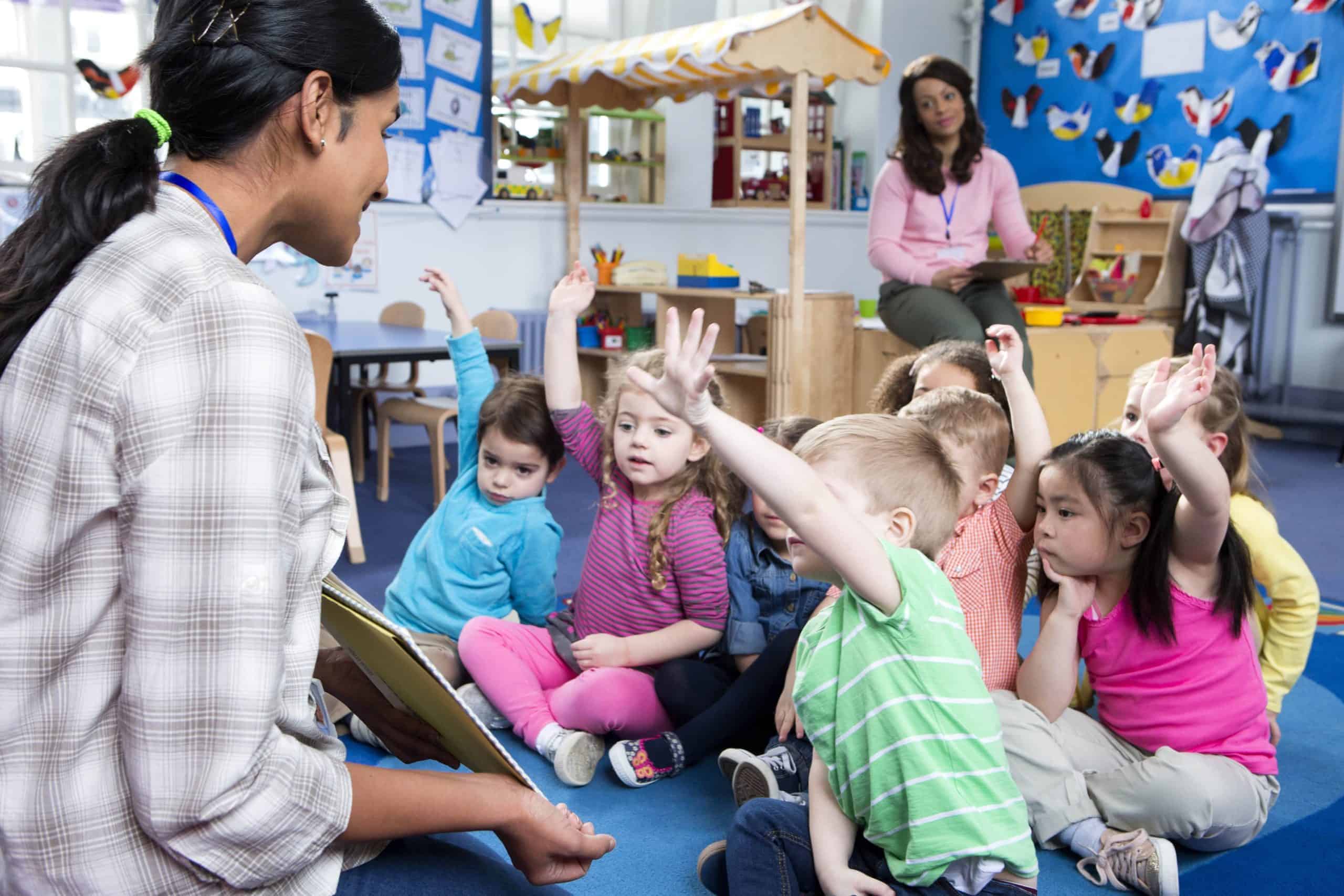
Our daycare for 3-year-olds starts with a welcome, breakfast, bathroom breaks, and time at classroom centers with sensory materials, then outdoor play. After a morning snack, the whole class gathers for circle time and a movement activity, then makes a craft tied to the theme.
Your child naps after lunch each day with a blanket from home. The afternoon includes a snack, more outdoor play with group activities, fine motor practice, and music and movement before dismissal. Bathroom breaks continue as needed, and room schedules can vary.
What your 3-year-old learns
Letters and sounds for 3-year-olds
Children learn how each letter looks and sounds, and they sing a song about it. The class covers three letters per month in order. It starts with A, B, and C in September and ends with Y and Z in May. Children pair capital and lowercase forms, then fill an oversized letter with dot markers or round stickers.
Early writing and scissors for 3-year-olds
Children trace lines and letters and practice prewriting strokes. Letters are taught in print only. Scissor work starts with straight, dashed cutting lines. Curvy lines are added in November, and zigzag lines follow in December.
Numbers for 3-year-olds
The class counts to 30, reviews numbers 1 to 10, then works on 11 to 15. Children count objects, recognize numerals, and put numbers in order. Worksheets add one new numeral a month, while jumping, clapping, marching, and hopping bring counting into movement.
Shapes and colors for 3-year-olds
Each month, your child draws and names a different shape, such as a circle, star, heart, or hexagon. Monthly colors run from September to April and include red, yellow, purple, and pink. That gives your family a new shape and color to look for together at home.
Thinking skills for 3-year-olds
Matching, finding which one is different, comparing big and small, and comparing more and less return each month. Children also finish patterns.
Music and art for 3-year-olds
Music and movement happen every day, with hand motions, animal sounds, and songs using kids’ names, letters, and counting. Each morning includes a fun theme craft. Children glue, fold, finger paint, sponge paint, and make crafts that stand up.
The world around us and manners for 3-year-olds
Picture cards and poems introduce topics such as animal homes, seasons, magnets, and gardening. Community-helper topics feature doctors and firefighters. Children also discuss healthy bodies, listening, kindness, and table manners. Group activities give preschoolers quality time with friends and practice with social skills.
The teachers in the 3-year-olds class
The 3-year-olds class has a Lead Teacher and an Assistant Teacher, and you can meet our teachers on our teachers page. Full-time staff complete 30 hours of annual training. Everyone on staff attends summer training through the Tennessee Association of Christian Schools.
New staff spend 30 days in orientation on emergency procedures and first aid. Teachers with CPR and first aid certification are onsite at all times. Before hire, every staff member passes a Tennessee Department of Health abuse registry check, a fingerprint-based background check through the Tennessee Bureau of Investigation (TBI) and the FBI, and a TBI/FBI sex offender registry check. Fingerprints are renewed every five years. These requirements mean trained adults are with your child all day.
Care and safety in the 3-year-olds class
- Your parent app gives you individual door access, and the entry log records who came in and when.
- You use a kiosk just inside the front entrance to check your child in and out, and a staff member goes with your child to class.
- Anyone else who picks up your child must be on your family’s list, be cleared with us in advance, and show government-issued photo identification.
- Visitors stay outside the secured interior doors while we are open.
Faith in a 3-year-old’s day
Large picture cards help teachers tell Bible stories such as Creation, Noah, Jonah, and the Good Samaritan. Children sing Bible songs and learn to pray with thanksgiving.
Children learn new memory verses and revisit verses from the prior school year. Prayer before meals and hymns bring faith into smaller parts of the day.
How you hear about your 3-year-old’s day
We use the Kangarootime parent app, email, and phone calls to stay in contact. Each week, you can see the classroom’s lesson plan. Classroom updates and a newsletter arrive monthly. A staff member usually answers you within one business day.
What comes after the 3-year-olds class
After the 3-year-olds class, your child moves up to Pre-K at age 4. Pre-K builds on the work your child does in this class.
What a parent says about the 3-year-olds class
We appreciate that the school is small and close-knit and mirrors the learning curriculum.
Questions about preschool for 3-year-olds
How is my child placed in the 3-year-olds class?
Children age 3 or older are placed by their age on August 15. Check that date against your child’s birthday.
Do 3-year-olds nap?
Yes, 3-year-olds nap every day after lunch, and you send a blanket from home.
Are meals included for 3-year-olds?
Yes, each day your child receives breakfast and lunch, plus morning and afternoon snacks, all included in tuition. You do not need to pack a lunch. No food containing peanuts comes into our peanut-free school.
Can my 3-year-old start in the middle of the year?
Yes, we enroll throughout the year, so a midyear start is possible. During your tour, we can tell you about openings for your child’s age.
What about tuition for 3-year-olds?
Supplies and materials, curriculum, and your child’s food are part of the single weekly tuition rate. We discuss rates during the tour and do not publish them here. Read more about preschool tuition.
Come see the 3-year-olds class
A tour of Spring Hill Early Learning Daycare and Preschool takes 45 minutes, and you can book it on our online calendar or by phone. We begin with safety and security, then discuss academics and Christian standards, and finish in the Pre-K room. Before your visit, look over how enrollment works.